 This site provides annotated Web links to instructional materials and other resources of interest to Chemistry teachers and course designers. The links are carefully selected to represent what this author considers to be the most useful and exemplary Web-accessible resources that others can draw upon for ideas and materials.
2017
The Modeling Method: A Synopsis (Instructional design) - The Modeling Method has been developed to correct many weaknesses of the lecture-demonstration method of instruction typically seen in STEM classrooms. These weaknesses include the fragmentation of knowledge, student passivity, and the persistence of naive beliefs about the physical world.
Isotopic Abundances and Atomic Weights (CIAAW home page) - See this official site of the Commission on Isotopic Abundances and Atomic Weights for the most current information on this essential data. There is also an interesting table showing how measured atomic weights have changed over the years, starting with Dalton.
Chemistry LibreTexts -The Chemistry LibreTexts library is a principal hub of the LibreTexts project, which is a multi-institutional collaborative venture to develop the next generation of open-access texts to improve postsecondary education at all levels of higher learning. The LibreTexts approach is highly collaborative where an Open Access textbook environment is under constant revision by students, faculty, and outside experts to supplant conventional paper-based books.
Note: Previous years' "recent additions" can be found here.
The Condition of STEM 2016 - This update on attainment of college and career readines is based on the results of the most recent ACT test on high school achievement and that was taken by 64% of US graduates. The results are presented mainly in the form of bar graphs and tables that provide a multi-dimensional breakdown of achievement and interests.
Communicating Science (extract) - By Roy Jensen is "an introductory guide for conveying scientific information to academic and public audiences". This is the Table of Contents and a sample chapter ("Fundamentals of learning") from the book, with links to sources. Those who still believe that lectures are valid means of instruction should look at Figure 3.2 of this document!
No More Pencils, No More Books - a 2015 Slate article by Will Oremus on how artificially intelligent software is replacing the textbook—and reshaping American education.
ACS High School Chemistry Guidlines and Recommendations describe broad requirements for teaching chemistry to high school students from diverse populations. These guidelines recognize the professional integrity of chemistry educators devoted to sharing and upholding best teaching practices and optimal facilities to achieve excellence.
Apple's new vision of education (Ryan Fass, ComputerWorld, 21 Jan 2012) - iBooks2 is part of Apple's plan to disrupt and reinvent education.
Wall Street Journal rapped over climate change stance - Leading scientists, including climate change experts, complain about opinion piece akin to 'dentists practising cardiology'.
Who's Afraid of Peer Review (Science 4 October 2013) - A spoof paper concocted by Science reveals little or no scrutiny at many open-access journals.
Online Chemistry degree offered by Western Governors University - WGU, an accredited online university, is offering a B.A. program in Science Education with a specialization in Chemistry. It is intended to prepare students for licensure as high school teachers. The laboratory component of the program is provided by a self-contained kit for use at home. A detailed program guide is available (PDF file).
In Budget Crunch, Science Fairs Struggle to Survive - (NY Times, Dec 2010)
A Quest to Explain What Grades Really Mean - U North Carolina confronts grade inflation (NY Times, Dec 2010)
Scientists Celebrate UK Libel Law Reform - New libel laws for England and Wales should help protect scientific debate, but campaigners worry that legal costs remain a threat.
In a Digital Future, Textbooks Are History (NY Times - August 8, 2009) This article describes how a combination of evolving student attitudes and the limitations and costs of conventional textbooks are encouraging the use of digital materials in the classroom.
Math Skills Suffer in U.S., Study Finds (N. Y. Times, October 2008) - The United States is failing to develop the math skills of both girls and boys, especially among those who could excel at the highest levels, a new study asserts, and girls who do succeed in the field are almost all immigrants or the daughters of immigrants from countries where mathematics is more highly valued.
Science Knowledge Quiz - "Test your knowledge of science facts and applications of scientific principles by taking our short 12-question quiz. Then see how you did in comparison with a nationally representative group of 3,278 randomly selected U.S. adults surveyed online and by mail between Aug. 11 and Sept. 3, 2014 as members of the Pew Research Center’s American Trends Panel."
First It Was Song Downloads. Now It’s Organic Chemistry. (N. Y. Times, July 2008) "All forms of print publishing must contend with the digital transition, but college textbook publishing has a particularly nasty problem on its hands. College students may be the angriest group of captive customers to be found anywhere."
Online, a free challenge to pricey college texts - article in Los Angeles Times, August 2008. See also Online 'open textbooks' save students cash (USA Today, July 2008)
Make Textbooks Affordable - Campaign to Reduce College Textbook Costs offers its report Exposing the Textbook Industry: How Publishers' Pricing Tactics Drive Up the Cost of College Textbooks. There are also many links to various facets of the Open Textbook movement. See also these comments by Nicole Allen of the Open Educational Resources (OER) movement that supports this site.
> "Don't try this at home" - a 2006 article from Wired Magazine that shows how suppliers of chemicals to scientific amateurs are being hounded out of business by U.S. terrorist-paranoia. See also {this page} from one of the afflicted companies.
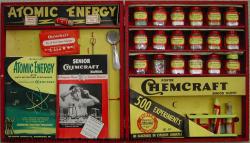 The Chemistry Set Generation - This 2007 article in the RSC's Chemistry World takes a nostalgic look at the now-bygone era of the home chemistry set.
Chemistry at Play - An article by Rosie Cook in the ChemHeritage Discover magazine outlines the history and demise of the chemistry set.
Banned: the Golden Book of Chemistry Experiments - a commentary by Chris Brunner.
Chemistry Sets, Past and Present - Great video report from Adam Rogers and Wired Science about the impotent chemistry sets being sold today and the glorious ones of the past. (Disappeared in 2010, no archive)
Math Wars! - an article that appeared in Education World. 'The TIMSS studies have incited a hot debate centered on the way in which mathematics is being taught in many classrooms in this country. Is a traditional approach better than a "whole math" approach? Which side will win out in America's "Math Wars"?'
Many Going to College Are Not Ready, Report Says (Tamar Lewin, NY Times August 2005) Only about half of this year's high school graduates have the reading skills they need to succeed in college, and even fewer are prepared for college-level science and math courses, according to a yearly report from AC.
Colleges Reinvent Classes to Keep More Students in Science - Story from The New York Times, Dec 26, 2014.
Online Learning - A 2009 U.S. Dept. of Education report Evaluation of Evidence-Based Practices in Online Learning
A Meta-Analysis and Review of Online Learning Studies
> {Student Alternative Conceptions in Chemistry} - This report, edited by Christopher Horton, is a product of the Modeling Instruction in High School Chemistry Action Research Teams held at Arizona State University in 2001-2004. It attempts to identify key misconceptions which impede student progress and to show how instruction can actually enhance these misconceptions. It was originally published in the California J. of Science Education 7(2) 2007, and can be downloaded as an 82-page pdf file.
How to Hold Colleges Accountable - "...45 percent of a sample study of more than 2,300 students demonstrated no significant gains in critical thinking, complex reasoning or writing after two years of college." (Op-ed from the New York Times, Feb 19, 2015.)
> Beyond Appearances: Students’ misconceptions about basic chemical ideas. This is an updated version of an extensive and carefully done report by Vanessa Barker for the Royal Society of Chemistry. Teachers and course designers can quickly find the material pertinent to a given topic, such as changes of state, stoichiometry, equilibrium, etc. This excellent resource can also be viewed, although in a less convenient format, here at the RSC site.. RSC has also published Chemical Misconceptions authored by Keith Taber.
Some other similar reports are listed on RSC's Chemical Misconceptions page
National Center for Case Studies Teaching in Science provides links to information, examples, workshops and conferences.
{Science and ...} - A ChemistryCoach site containing many links to ethics, gender, art, literature, poetry, culture, race, politics, religion, etc. (Link is to last archived update, 4/2007.)
Statement on Computer Simulations in Academic Laboratories - the "official ACS position".
The Status of High School Chemistry Teaching is one of a series of reports based on data from the 2000 National Survey of Science and Mathematics Education, a survey of 5,765 science and mathematics teachers in schools across the United States. Areas addressed include: teacher backgrounds and beliefs, needs for and participation in professional development, course offerings, instructional objectives and activities, and instructional resources. The report itself can be downloaded as a PDF document.
What is Chemistry? Two places to start: European Chemistry Thematic Network, Steve Lower's one-web-page overview.
Perspectives of Chemists: Tracking conceptual understanding of student
learning in chemistry at the secondary and university levels - Describes a chemistry curriculum and assessment
project that has framed the “big ideas” of chemistry in order to provide developmental cohesion
and promote conceptual understanding for students. (Stacey Group, UC-Berkeley, 2003)
General
Chemistry Trivia Quizzes - this site provides access to a variety of quizzes from different sources.
chemistry.org Joke-a-Rama - guaranteed by the American Chemical Society to make you laugh.
Chemistry jokes - this well-organized collection is part of a more general science humor site.
Chemistry riddles - Note: there are multiple pages on this site.
Sidney Harris Chemistry Cartoons (Science Cartoons Plus) - a showcase of this well-known science cartoonist's work.
The Science Trivia site has a special section devoted to Chemistry topics.
{Scientists at work cartoons} - a nice collection, but an almost unreadable color combination on the home page. (Last archive from Feb 2007)
Comic book periodic table - "... and now for something completely different." This popular classic is by John Selegue and James Holler of the University of Kentucky.
"Never mix alkali metals with water" - "not your usual boring science video" from Braniac Science Abuse (Movie; 3 min 16 sec)
Kelvin is Lord!! All praise Lord Kelvin! A spoof cult site for the thermodynamically inclined.
Molecules with silly or unusual (or suggestive) names - an amusing and informative site by Paul May of Bristol U. (UK) that will likely have special appeal to teen males of all ages.
Science humor WebRing - some of it is pretty corny, but it's more fun than balancing redox equations.
The story of Schroedinger's cat (an epic poem) by Cecil Adams
The Table of Condiments that Periodically Go Bad — taking the periodic table a bit too far!
Dangers of Dihydrogen monoxide: the National Exposure Warning Center's Dihydrogen Monoxide Research Division.
Games and activities
Sciences Jeopardy! Games - this U Pittsburgh site covers general, organic, analytical and biochemistry.
ChemBalancer and Element Quiz - four games you can play online.
ChemDoku is a logic puzzle game similar to Sudoku (Windows-only download).
ChemGameTutor - A graphically-interesting design intended to help refine Chemistry knowledge by Peter Lichten. The author invites inquiries from teachers who would like to incorporate the game into a class-wide competitive activity in which students can compare their scores.
Give Them Money: The Boltzmann Game, a Classroom or Laboratory Activity Modeling Entropy Changes and the Distribution of Energy in Chemical Systems. PDF or Zip download of printed material including Instructor Notes.
A large collection of Chemistry drills, some in the form of arcade games, can be found at the {DigitalGraphics site}. These are Windows-only, and many are shareware. (Last archive 2/2006)
Science-related songs
The MASSIVE database contains information on over 1700 science and math songs, many available as MP3 downloads.
Another large collection can be found at Chem Classics Collection by Mark Rosengarten - a DVD collection of clever Chemistry videos, including his earlier "30 Songs of Chemistry".
Other sources:
Tom Lehrer's "The Elements" song - animated sing-along version, and other Tom Lehrer links for nostalgic boomers.
Not all science songs are for the kiddies; {metabolic Songs} (with text and audio music tracks) intended to help biochem students keep track of all those metabolic pathways. (Paul Price, UCSD) Sample: Glucose, by hexokinase is turned to G6P / (You might use glucokinase, you must use ATP)
{Chemistry Department Web Sites} - this excellent collection covering U.S. 4-year colleges was maintained by Chuck Huber at UCSD. This site disappeared in 2011; the link is now to a [non-updated] archive. For non-US sites, see Michael Barker's extensive list .
Mineralogy - an extensive listing of sites dealing with mineralogy.
Nobel Prizes in Chemistry - from the official Nobel Society site (with links to photos and biographies); Wikipedia's list is more concise and informative. Another concise list with pictures, but not up-to-date.
KnowledgeDoor - an excellent compendium of Chemistry- and Science-related data, in many ways more comprehensive than the Handbook of Chemistry and Physics, and certainly more convenient to use. Should be bookmarked by every serious Chemistry student!
{Units, measures and conversions dictionary} - provides a summary of most of the units of measurement to be found in use around the world today (and a few of historical interest), together with the appropriate conversion factors needed to change them into a 'standard' unit of the SI. [Link is to a 2007 archive]
Web sites of U.S. public schools, community colleges, 4-year colleges and universities.
Elements - ever wonder which of the less-common ones you can buy, and in what form? This commercial page from American Elements provides a quick reference.
The Internet Encyclopedia of Science - this extensive A-Z collection by David Darling covers many Chemistry topics.
Chemistry Explained: Foundations and applications - At first glance, this site appears to be just an A-Z index to a series of short definition of the many topics it covers, but clicking on the name of the topic itself brings up a fairly detailed (but anonymously composed) description or exposition of the subject.
Chemistry: A project of the American Chemical Society - this review by Jeffrey Kovic, entitled "A new way to learn Chemistry", appeared in the July 19, 2004 C&EN.
{CTI Web Reviews} - selected reviews of Web sites devoted to various areas of Chemistry. (Link is to April 2007 archive.)
Books of interest to chemistry teachers - (formerly Hal's Picks of the Month) is now part of the ChemEd Xchange and contains recommendations and some brief reviews from registered users.
Uncle Tungsten - this review of the late Oliver Sack's evocative recollection of his early fascination with Chemistry appeared in the New York Times in November 2001.
A matter of degrees: What Temperature Reveals About the Past and Future of Our Species, Planet, and Universe. By Gino Segrè. (NYT, 2002)
Never send a human to do a Machine's Job: Correcting the Top 5 Educational Technology Mistakes - This Oct 6, 2015 op-ed in the Washington Post excerpts an introduction to the book of this title. "Cyclic amnesia best characterizes the history of technology in education.” That is part of the following post about the mistakes in educational technology that keep being made decade after decade — and about how to fix them."
Cognitive Science for Chemists: "Do we need to memorize that?" This link is to a pre-publication draft of an article by JudithAnn Hartman and Eric Nelson that was published online by the journal Foundations of Chemistry. More information on its content can be found in this note on the ChemEd-L mailing list.
ChemWiki: The Dynamic Chemistry E-Textbook - a collaborative approach toward chemistry education where an Open Access textbook environment is constantly being written and re-written by students and faculty members resulting in a free Chemistry textbook to supplant conventional paper-based books. The material is organized into sections for analytical, biological, inorganic, organic, physical and theoretical chemistry. Each of these contains topics ordinarily included in "general" chemistry, as well as more advanced ones that go beyond first-year college level.
General Chemistry Online! - an interactive guide to college chemistry, maintained by Fred Senese of Frostberg State University (MD). A well-organized wealth of material, including collections of notes and guides for introductory General Chemistry, skills checklists and online self-grading examinations, and a Q&A column.
General Chemistry: starting points for students is a carefully-made selection of the best links for students enrolled in General Chemistry courses at the HS, AP, and college levels. Instructors who have Web pages for their own courses are invited to link to this site, or they may use it as a basis for building their own.
The ChemCollective "is a collection of virtual labs, scenario-based learning activities, and concepts tests which can be incorporated into a variety of teaching approaches as pre-labs, alternatives to textbook homework, and in-class activities for individuals or teams. It is organized by a group of faculty and staff at Carnegie Mellon University for college and high school teachers who are interested in using, assessing, and/or creating engaging online activities for chemistry education."
Chemical Education Digital Library - "ChemEd DL seeks to provide exemplary resources for chemistry teachers and students—resources that are versatile and reliable tools that span all aspects of chemical education, from middle school science through college-level classes and topics. Our collection includes interactive simulations, tutorials, activities, wikis, reference materials, images, video and even more."
Elemental discoveries A monthly 'zine featuring chemistry topics and reviews.
 General Chemistry - a free textbook compiled from the work of various authors. It is available in the format of a "help" file that works with MS Windows. Please see here for details.
The Chemogenesis Webbook - this extensive, excellent and comprehensive site by Mark Leach tells how chemistry emerges from the Periodic Table and bifurcates into the rich and extraordinary science that we know and experience.
Tanner's General Chemistry - a large collection of pages on matter (including quantum theory), physical chemistry, electrochemistry, and aqueous solutions.
The Alchemy virtual library An extensive collection of texts, graphic images and book references assembled by Adam McLean. See also this nicely-done list of Elemental Alchemy Symbols.
WikiBooks on Chemistry - Many topics in general chemistry are covered here, and are worth looking at. But as in any "wiki-" type project to which anyone can contribute, the quality is variable, and the visual design is primitive.
Student Assment of their Learning Gains (SALG) - The SALG website is a free course-evaluation tool that allows college-level instructors to gather learning-focused feedback from students. It provides tools for measuring students' learning gains in a course, or to conduct a baseline survey to discover students' starting points. More information here.
The MICROSOC Computer Assisted Testing Files - This question bank was originally developed in the 1960-70s at Calif. State U - Dominguez Hills. It contains thousands of items, is in the public domain, but needs reformatting to be really useful to teachers.
BestChoice (Sheila Woodgate, University of Auckland, NZ) provides interactive quizzes on a large variety of General Chemistry topics. A hierarchical menu offers quick access to each section which contains one or more review screens and a large number of questions selected through a pull-down menu; approximately 2500 pages are presently available. Free registration is currently available to non-UA users. Rather browser-sensitive; works well with IE on Windows/Mac.
Online Quiz from Alwyn Botha covering elementary General Chemistry with special emphasis on the periodic table.
CSUDH Electronic Homework system is an elaboration of an earlier Web-based exercise system developed by George Wiger at California State U.- Dominguez Hills. This site appears to have died (2011)
i-assign ( formerly listed here as chemistry online homework system) eveloped by Glen Lo and colleagues at Nicholls State U (LA). Visitors can try out the system by clicking on the "guest" tab. Online guides for students and teachers are also available.
Chemistry homework help - this compilation of sites, some free, some pay-per-answer, is the last resort for the desperate or the lazy.
ConcepTest Collection A collection of downloadable quiz questions. They are intended mainly for presentation in lecture or tutorial classes. Students vote on the possible answers, then try to persuade their neighbors in the lecture room that they are correct, and finally vote again. This form of peer instruction is often an effective pedagogical method, and it also provides the instructor with on-line feedback as to how well the class is following the lecture.
ChemSkill Builder (Electronic Homework Systems) is a commercially-available suite of PC-based lessons for general-, prep- and organic chemistry designed to be used as electronic homework. Scores earned through the use of CSB are stored on a student disk for later addition to a course file.
{How to deal with ill-posed questions} - this anonymous page has some useful advice for teachers and students. (≤ 2006)
WebAssign is a homework delivery service that provides questions taken directly from major textbooks (about 30 Chemistry texts are covered) and also allows instructors to edit or create their own questions, which may involve variables and randomizing.
We_Learn is a Web-based homework distribution and grading system for Chemistry courses. The questions are taken from a very large database (to which new items can be added) and are assigned through protocols based on either specific topics, or distributed over a variety of topics as would be appropriate for a practice examination.
Examples of institutional homework systems
Contact the developer/administrator for information about the availability of these systems to outside institutions.
Chemistry Online Homework Systemdeveloped by Glenn Lo and Michael Janvsa of Nichols State U (LA). (≤ 2008)- Homework Service - U Texas Austin (gone)
Atomic Weights of Ten Chemical Elements About to Change - and you thought that atomic weights were forever? See this December 2010 news release from the US Geological Survey!
{Bubbles in Beer} - Eric Maiken shows how a freshly poured glass of beer (or Champagne) illustrates some general physical properties of bubbles. [≤ 11/2007]
The Chemistry of autumn colors - an informative page from the Shakhashiri/U. Wisconsin Science is Fun site.
{The Chemistry of Tea} - mainly about polyphenols [≤ 07/2011]
The Chemistry of Egg Whites - an unusually well-done treatment of this topic.
How to boil an egg - all about eggs and the science of hard-boiling them by Charles Williams (U Exeter, UK)
Why is mercury a liquid at STP? - a brief discussion about electrons at relativistic velocities.
{Glossary of archaic chemical terms} - from C. Giunta's excellent collection of history-of-chem materials. (Archived copy 3/2013)
Stain removal - How to remove just about every kind of stain you can think of: try one of these. A to Z Guide - American Cleaning Institute - And this one features a "guide to stain removal guides".
Chemistry of Cleaning - a nice overview of the nature of "dirt" and the agents used to get rid of it. Another useful soure: the York U. (UK) page How do detergents work?" features some simple experiments on soap bubbles and surface tension. Chemistry behind cleaning contains many useful links to other sites.
{The Happy Drinking Bird} - all about the various subspecies of "dippy birds", their history, and how they work. (Link is to last archived copy 7/2007)
Skunk Chemistry - what's the big stink about? This rather technical article tells the story of how we have come to know what we know.
What is Chemistry good for? A thoughtful answer to a common question in terms of the stoichiometry of carpets - from Illinois U - Perdue U - Indianapolis.
What's in a modern laundry detergent? Surfactants, builders, flllers, brightening agents to attract consumer dollars.
What's that stuff? - Archive of those interesting one-page articles that appear occasionally in Chemical & Engineering News.
Why Did My Skin Turn Green? How to keep jewelry from discoloring your skin.
Why is water blue? What causes the blue color that sometimes appears in snow and ice? These are just two of the more interesting pages at the Webexhibits Causes of Color site.
> {Food Science Resources} - additional material intended for teachers who wish to incorporate food science into their courses.
(≤ 8/2010; link is to an archived version)
Bad Chemistry
This Bad Chemistry page by Kevin Lehmann of U. Virginia takes a poke at the hydrophobic effect, the common explanation for how ice skating works, and the nature of ionic solutions.
TextRev is a free tool for instructors who wish to generate a customized Web-based survey for their course. The survey provides picture of how much time students spend each week using the textbook, CD-ROM, web site, solution manual, etc. It will also inform you of how helpful students find particular features of the text, e.g., images, sample problems, real-world examples. The site also post aggregative reviews of selected texts.
Open Library: Chemistry - This remarkable site, affiliated with archive.org, is an open, editable library catalog, similar in some ways to Wikipedia. One of its most interesting features is that many of these titles can be "borrowed" as eBooks; many of the older, out-of-copyright ones can be browsed as digitized images. The Chemistry section contained about 2300 titles in October 2015. This resource is a treasure-trove for those who are interested in historical trends in Chemistry teaching over the years.
Archive of freely dowloadable textbooks - these are mostly entry-level textbooks from an unnamed publisher who offered these for free download under a Creative Commons licence up through 2012. (From 2013 on, texts from this publisher were no longer free, but the CC license is still valid for the earlier editions.) The only Chemistry title is Principles of General Chemistry by Bruce Averill and Patricia Eldredge, but other titles on this list may be of interest to home schoolers and teachers in countries where textbooks are unavailable or unaffordable.
extRev is a free tool for instructors who wish to generate a customized Web-based survey for their course. The survey provides picture of how much time students spend each week using the textbook, CD-ROM, web site, solution manual, etc. It will also inform you of how helpful students find particular features of the text, e.g., images, sample problems, real-world examples. The site also post aggregative reviews of selected texts.
AR Textbooks, Virtual Chemistry Sets & the Future of Learning - a Dec 2010 article on Augmented Reality technology from ReadWriteWeb.
{Make Textbooks Affordable} - Campaign to Reduce College Textbook Costs offers its report Exposing the Textbook Industry: How Publishers' Pricing Tactics Drive Up the Cost of College Textbooks. There are also many links to various facets of the Open Textbook movement. (This site disappeared soon after its launch in 2007; Link is to an archive.)
Online, a free challenge to pricey college texts - article in Los Angeles Times, August 2008. See also Online 'open textbooks' save students cash (USA Today, July 2008)
Catalogs and lists
Books of interest to chemistry teachers - (formerly Hal's Picks of the Month) is now part of the ChemEd Xchange and contains recommendations from registered users.
Free downloads of selected advanced Chemistry text- and reference books - see here - lots of biochemistry, electrochemistry, Greenwood & Earnshaw's Chemistry of the Elements....
Online Books on Chemistry at the Library of Congress - this extensive index is arranged by LC catalog number. From Boyle's Skeptical Chymist to my own Chem1 Virtual Textbook, it's all here! And if you wonder how all those Chemistry catalog numbers starting with Q are organized, see here.
Software (non-instructional)
> KnowItAll® Academic Edition, free for students and teachers, includes tools for structure-drawing, spectral display and analysis, lab report generation, and molecule display.
Visual media
Chemistry Video Consortium maintains a regularly updated list of more than 1000 films, VHS tapes, laser discs, CD ROMs and DVDs. This UK effort is associated with the Royal Society of Chemistry. There are separate sections for viewers over and under age 16. (≤2010; access to archive has been blocked by RSC)
IUPAC Committee on Chemical Education: Development of a framework of priorities for IUPAC Committee on Chemistry Education - This project began in 2009, and as of 2014 was continuing.
Science Online Access to Science Magazine and AAAS pages
American Chemical Society
ChemCenter Home Page - ACS main resource site, including ACS Journals on the Web and STN.
ACS Division of Chemical Education Information about the CHED division, divisional resources, and information of interest to chemistry educators and students.
Examinations institute - ACS DivChemEd offers standardized exams and normative information for high school and college chemistry subjects.
The Computers in Chemical Education Newsletter is an online publication, edited by Brian Pankuch, containing articles describing a wide variety of topics relating to the use of software and Web-based materials in instruction.
Chemistry Education Discussion Group (on Google Groups) replaces the old CHEMED-L mailing list that disappeared in August 2011. It provides a forum for discussion of matters of interest to chemical educators at all levels.
Chauttauqua short courses for college Chemistry teachers is an NSF-sponsored program for faculty development. Several courses, on varied topics, are offered every summer.
The Chemical Educator An independent journal distributed via the Internet.
Chemical Heritage Foundation The Chemical Heritage Foundation is attempting to provide a comprehensive list of resources on the history of chemistry available through World Wide Web, as well as access to CHF's collections.
Clemson University web site Clemson University web site. Information on the ACS Examinations Institute.
HYLE A Web-based international journal dedicated to all philosophical aspects of chemistry. Many useful links to conferences, courses, journal articles, and a bibliography with more than 1500 titles.
Journal of Chemical Education
- Home Page - also J. ChemEd Software
- Journal of Chemical Education Index To access the on-line, searchable index to this important resource, use the search box at the upper right corner of the ACS Pubs JCEd page.
National Science Teachers Association - the NSTA home page, > Journal of College Science Teaching
Scientific American This site contains Web-viewable and hyperlinked versions of selected recent articles. Whatever happened to the useful cumulative indices of the past?
Education in Chemistry - Royal Chemistry Society's analog of J Chem Ed. Selected articles are available to non-subscribers.