The Alchemy Web Site and Virtual Library by the noted scholar Adam McLean is an extensive and meticulously organized collection of information on alchemy in all its facets. Divided into over 1300 sections and providing tens of thousands of pages of text, over 1700 images, over 200 complete alchemical texts, extensive bibliographical material on the printed books and manuscripts, numerous articles, introductory and general reference material on alchemy.
Practical Alchemy - a more compact site, nicely arranged and containing a lot of graphics.
Elemental Alchemy Symbols - a nice listing with good graphics
Art, Artifacts, Archives & Photos - This Chemical Heritage Foundation site offers a searchable database of items in CHF’s collections. It contains sections on Fine Art (ranging from alchemy through the 19th century), Instruments and Artifacts, Photographs.
Chemical Genealogy Database- this unusual site traces a person's intellectual line of descent via one's PhD advisor or mentor for one's highest non-honorary degree.
Carmen Giunta's classic chemistry page - A major resource for the history of chemistry. Includes Selected Classic Papers, a collection of materials organized by topic and person, with links to biographical data and images. His "This week in the history of chemistry" is a nice link to add to any course home page.
Dan Berger's History of Chemistry bookmarks - another good source which includes information on related organizations and mailing lists, philosophy of chemistry, alchemy.
> {Discovery and naming of the chemical elements} - this site by David Trapp organizes the elements according to whether their names are derived from celestial objects, places, minerals, etc. (2001-2009)
Discovery of the elements - > {Elementistory} (2/2003) provides very brief summaries; the Los Alamos periodic table offers more comprehensive information.
 Elemtymology & Elements Multidict
- This site, by Peter van der Grogt, presents his own etymological
research on the names of the elements, and names them all in 97
different languages.
Elemtymology & Elements Multidict
- This site, by Peter van der Grogt, presents his own etymological
research on the names of the elements, and names them all in 97
different languages.
Evolution of the Atomic Concept and the Beginnings of Modern Chemistry - text of a lecture by Michael Fowler of U Virginia. The early Greek philosophers through Mendeleev.
Geschichte der Chemie (English version) is a treasure trove of links to resources as diverse as the Pauling papers, histories of various chemical industries, information on individual chemists (including some lesser-known ones) and relevant museum sites.
Glossary of archaic chemical terms - from C. Giunta's excellent collection of history-of-chem materials.
 History and Timeline of Green Chemistry - a nice summary on a commercial site.
The History Section of the Google Chemistry directory has an uneven, although possibly useful collection of links.
{Historical online chemistry textbooks} - a site being developed by Bill Palme; contains the indexed text of the 19th century textbook "Elementary Chemistry for Science Schools and Classes" by Robert Avey Ward. (Link is to last archived version, Feb 2006.)
{History of Chemical Engineering and Chemical Technology} -(1997-2010) Part of a now-dead site (Exploring and Collecting History Online), a directory to 5,000+ websites concerning the history of science, technology, and industry.
Islamic Chemical Technology - a brief survey of work of two chemists of the medieval period. Mentions discovery of the mineral acids and the distillation of vinegar.
{StudyWeb History of Chemistry site} contains a wealth of links to history-related sites.
{The History of Chemistry} (1992 Woodrow Wilson Summer Institute) - much more thorough coverage (but of fewer chemists) than in the previous entry, organized by field. (≤ 2006)
History of the "human molecule" - the molecular definition of a person. A bit far-out, but interesting.
Marie Curie and the Radium Craze - (a PBS video) "After Marie and Pierre Curie’s discovery of radium, the new element’s wondrous ability to glow in the dark inspired a worldwide craze — a rush of radium-laced products that promised to cure everything from impotence to hair loss. What few people realized — and the Curies were reluctant to admit — was the great harm this radioactive element could do."
Old Textbooks
An Elemental Study of Chemistry (1906) by McPherson and Henderson provides an interesting view of how chemistry was taught at that time. This Project Gutenberg edition is also available in various E-book formats, including Kindle; details here.
 Chemistry Sets
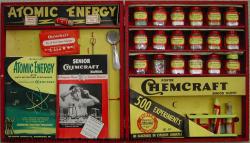
The Chemistry Set Generation - This 2007 article in the RSC's Chemistry World takes a nostalgic look at the now-bygone era of the home chemistry set.
Chemistry at Play - An article by Rosie Cook in the ChemHeritage Discover magazine outlines the history and demise of the chemistry set.
Chemistry Sets, Past and Present
- Great video report from Adam Rogers and Wired Science about the
impotent chemistry sets being sold today and the glorious ones of the
past. (Disappeared in 2010, no archive)
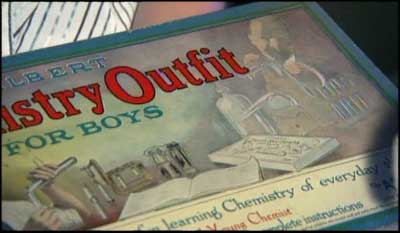
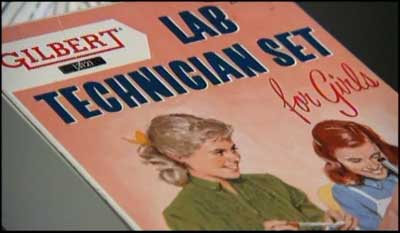
Chemistry set sexism
Banned: the Golden Book of Chemisry Experiments - a commentary by Chris Brunner.
Atoms and atomic Structure Timelines - Here are several that should fill most needs:
- The History of the Atom - a fairly simple one 400 BCE - 2000 with illustrations by Pradeep Elankumaran
- Wikipedia has a much more complete Timeline of atomic and subatomic physics 585 BCE - 2008 with lots of links
- This more compact timeline, with links, by Lee Buescher.
ChemSoc timeline - a visual exploration of key events in the history of science with particular emphasis on chemistry. This elaborately-organized UK site allows one to explore the development of specific concepts (or individual chemical elements) over time.
History of Chemistry - timeline of developments from 1700 BCE to 1940. (Columbia U)
What happened and when - a brief, annotated timeline of Chemistry
This Week in the History of Chemistry - part of Carmen Giunta's (Le Moyne College) excellent Classic Chemistry site, "This Week" presents mini-timlines covering the current two-week period.
"Top 75" contributors to Chemistry
- pictures and brief bios of the people C&EN's readers judged to
have made the greatest contributions over the 75 years up to 1998. (ACS has removed this from free public access; members may view it at this link)
Biographical information on famous chemists - the Chemistry section of Eric Weisstein's Treasure Trove of Scientific Biography contains somewhat-too-brief bios of 95 notables from the Alchemists to Ahmed Zewail.
Brief History of the development of the periodic table from Western Oregon U discusses the work of some of Mendeleev's predecessors.
Heisenberg and the history of quantum theory - a nicely presented and thoroughly readable summary from the American Instritute of Physics.
ChemTeam photo gallery - extensive collection of portraits/photos of eminent physical scientists and of some historic apparatus.
Linus Pauling Lectures - This Oregon State U. site has videos of several NSF-sponsored lectures by Pauling.
Oral History: Reflections on the Discovery of the Calvin-Benson Cycle - a 33-minute YouTube video and a PDF transcript are available. (UC-Berkeley)
Nobel Prizes in Chemistry - from the official Nobel Society site (with links to photos and biographies);
Wikipedia's list is more concise and informative. Another consise list with pictures, but not up-to-date.
Roger Bacon: On Experimental Science, 1268 - the original words from the father of the scientific method.
The Crime of Galileo: Indictment and Abjuration of 1633 - read here about his horrible crime.
Dmitriy Mendeleev Online - all about the father of the Periodic Table
Isaac Newton virtual museum (Andrew McNab) - links to all aspects of his life and work.
Percy Julian - The producer's story: rediscovering a forgotten genius - this site describes the development of a NOVA documentary on the life of this 20th-century African-American chemist.
This timeline of discoveries in all the sciences provides an excellent view of how the various displines developed in concert with one another. This compilation, by Ken Kohler (which he titles Biophysical Chronology) is exceptional in the amount of detail it provides (there are many Web links), especially in the widely-neglected era of Islamic culture that fluorished during the Western "dark ages". Highly recommended!
Internet History of Science - An extensive set of links, very nicely indexed according to period and place, taken from three even larger "History" sourcebooks covering the ancient, medieval, and modern period.
History of Chemical Engineering and Chemical Technology - ECHO (Exploring and Collecting History Online) is a directory to 5,000+ websites concerning the history of science, technology, and industry. You can search it, browse it according to category, or even look at the tag cloud we've generated.
How Islam Won, and Lost, the Lead in Science - 1000 years ago, science thrived in Islamic cultures while the Western world wallowed in the dark ages. This inciteful New York Times article traces the decline of science in Islam to its present sorry state. (Newcomers to the Times Online site will need to register, but it's free.)
Medieval Technology - a large collection of links nicely indexed by subject, and a timeline. (Paul J. Gans)
TimeLine of Science - a linear-based exploration of key events in the history of science with a particular emphasis on Chemistry (Royal Society of Chemistry, U.K.)
Today in Science History - An excellent resource by Ian Ellis, updated daily but with links to any day of the year.
The Fine Arts and Science - this Colby College page presents some examples of the breakthroughs in art and music which concided with the development of Gibbs' free energy (impressionism) and quantum mechanics (abstract art.)